Coaching articles · From Coach Drew’s desk

Coaching Articles — From Coach Drew’s Desk

These aren’t blog filler. They are the actual handouts Drew gives his coached athletes — the principles, zones, power and fueling guidance his riders train by, published here in full. Tap any article to read it.

Featured · Drew’s coaching method

Progressive Overload, Specificity, Individualization

The three concepts Drew returns to for every athlete he coaches — how overload actually makes you faster, why the plan has to fit the individual, and why training has to get specific to the event.

Read article ↓Close ↑
Drew Edsall riding at sunset

These are the main concepts and principles I use for every athlete I coach. This is the science behind building periodized training plans for athletes.

Concept #1: Progressive Overload

To improve, you have to overload your body. Meaning, make things tougher in order to improve. This “overloads” your body, and then with the right amount of rest your body supercompensates — leading to more power, more efficiency, and ultimately just a faster and stronger you!
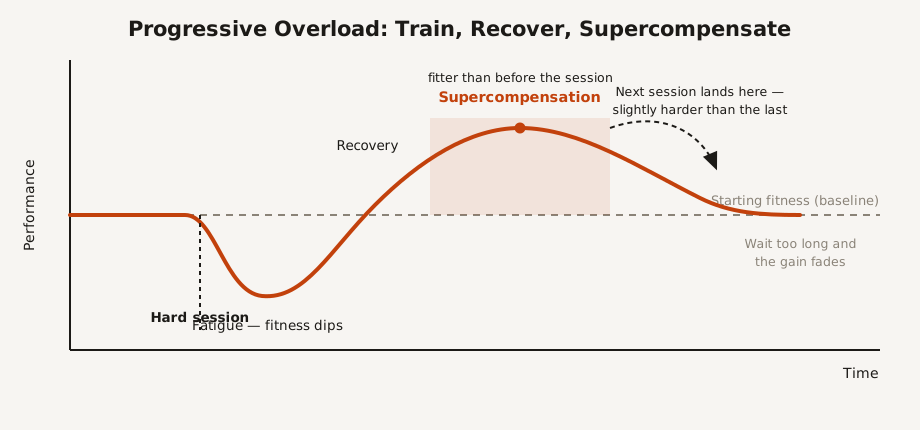
Diagram of the supercompensation cycle: a hard session overloads the body, performance dips with fatigue, then recovery lifts it above the previous level

There are two main ways to make your training tougher and lead you to getting faster:

  • Volume: simple — make rides longer (i.e. base training)
  • Intensity: makes things tougher (i.e. intervals)

Volume. Adding volume is a great way to challenge your body. It is the most common form of traditional base training: add more miles and time for 2–3 months at the beginning of your training year. This is very much based on this “volume concept,” and it does the job of challenging your body. There are advantages to doing these straight base miles (long rides, Zones 1–3 and steady): increased fat utilization, increased threshold, increased mitochondrial density, increased cardiac output, etc. But this model often presents a common problem: it requires more time.

Going back to progressive overload — if you don’t make it harder than previous years (meaning more time on the bike), it will most likely lead to you coming back into the season in similar shape as last year… because you gave it the exact same overload. If you are a Pro rider, maybe that 20–30 hour week set you up well and you want to repeat it. Fantastic! You are a Pro and that’s all you do! The majority of riders out there do not have that amount of time to train. Meaning, if you spent 14 hours a week training last year on base Zones 1–3 rides, and you do the same this year, you are producing a very similar overload and will most likely see a similar state of fitness come race time.

The average rider does not have the time, especially in the winter, to progressively make this tougher. 12–16 hours is the typical max for most riders per week. If you are not the “average” rider and have more time: great! Add more time to the training plans! Maybe more base is good for you. But the plans I put together take into account what I feel is best for the average rider for the specific racing you are doing, and apply the best concepts possible.

Many times this means we are overloading the weekend rides with volume, because you have more time to train on the weekends. Overloading the weekends still gets you the volume benefits I mentioned earlier. And it fits most riders’ schedules better.

And during the week we are overloading with intensity, because many athletes have full-time jobs and other commitments. So time is an issue during the week. 2–5 hour rides are tough to get in — and that’s what traditional base training is about… long, steady rides!
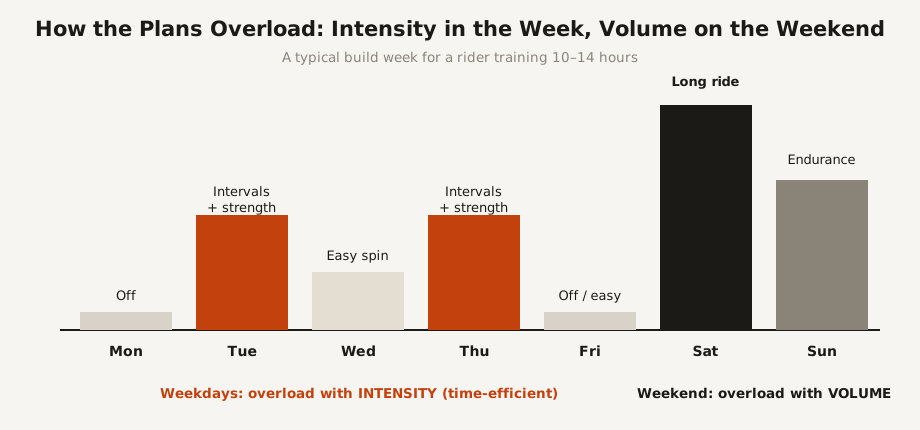
Diagram of a sample training week: intensity and strength on Tuesday and Thursday, long ride on Saturday

Intensity. That brings us to the next point. High-intensity short efforts are a very common way to drive improvement, both for mountain bike racing and gravel racing. Specific targeted intervals have race-proven results and are scientifically proven methods of improvement. Google the terms HIIT, Threshold Training, or Tempo, and look over the research articles you find. Intervals give you a lot of bang for your buck: less time on the bike, with a lot of results! Do these right, and you will come into the early season riding very well — and with the right maintenance and transition, come into your top races riding strong also. On top of that, you can easily overload your body every week without needing to increase your time during the week. And you get great benefits!

Going back to the main concept: progressive overload. Pick either intensity or volume, and focus each ride, week, or month on building this specific energy system. The effort needs to be longer or harder than previously. With the proper rest, you will improve and continue to get better.

Concept #2: Individualization

The training plan should be specific to the individual. That’s you! Here are a few areas to consider:

  • Age
  • Past fitness and sports background
  • Time to train
  • Type of athlete: what drives you
  • Strengths and weaknesses
  • Goals

Evaluate these by asking lots of questions and getting to know yourself better. Try to determine what drives you, and how to manipulate the training to best suit that need. Also take into high consideration the sports you have played in the past, your strengths and weaknesses, and the time you have to train. And age — age can make a dramatic difference in your recovery rate and your ability to train.

Concept #3: Specificity

Get specific to the event you are getting ready for.

The timing of this is important also. Typically, starting 2–3 months before your key event(s), you will want to make sure a majority of your key workouts are specific to that event. i.e. If you are expecting lots of 1–3 minute climbs, then incorporate training designed around that. If it’s a longer race, then make sure there are rides building up to that distance — and ideally building up to that intensity also.
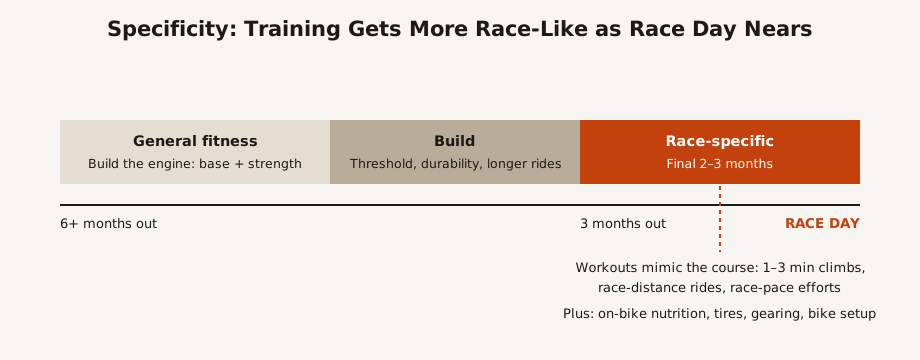
Diagram of training specificity: general preparation narrows through build work to race-specific work in the final two to three months before the event

If you’re getting ready for mountain bike racing, that might be a combination of time trial work on the trails, more rides on mountain bike trails, and race intervals geared toward that specific race. Gravel racing might include more group rides combined with intervals specifically designed around the gravel race you are getting ready for. The Rad Dirt Fest, for example, is long steady climbs, whereas UNBOUND is an entirely different animal — shorter rolling hills mixed with headwinds much of the time. Other things to consider to improve specificity: nutrition on the bike, tire and bike selection, gearing selection, bike setup. These are all very important, and getting more and more specific starting 2–3 months out can give you an advantage over your competition and prepare you better for race day.
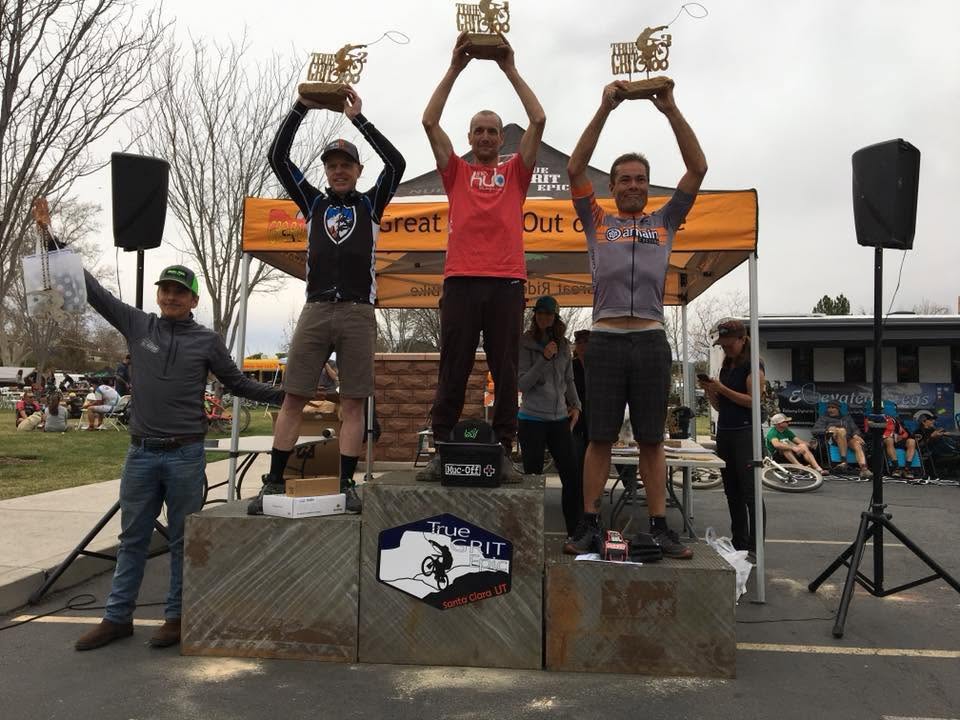
True Grit podium, 2018
Race day is where the three principles cash out.

These concepts are the main ones I focus on when looking at an athlete, and as a coach I will continue to evaluate these throughout the year(s) I work with each athlete. If you nail these down, it will help you analyze your training and help you continue to improve throughout the season and years.

Every plan at Edsall Coaching is built on these three principles: overload that fits your life, built around you, and specific to your race. Browse the training plans →

References

  1. Meeusen, R., et al. (2013). Prevention, diagnosis, and treatment of the overtraining syndrome: Joint consensus statement of the European College of Sport Science and the American College of Sports Medicine. Medicine & Science in Sports & Exercise, 45(1), 186–205. doi:10.1249/MSS.0b013e318279a10a
  2. Issurin, V. B. (2010). New horizons for the methodology and physiology of training periodization. Sports Medicine, 40(3), 189–206. doi:10.2165/11319770-000000000-00000
  3. Holloszy, J. O., & Coyle, E. F. (1984). Adaptations of skeletal muscle to endurance exercise and their metabolic consequences. Journal of Applied Physiology, 56(4), 831–838. doi:10.1152/jappl.1984.56.4.831
  4. Joyner, M. J., & Coyle, E. F. (2008). Endurance exercise performance: The physiology of champions. The Journal of Physiology, 586(1), 35–44. doi:10.1113/jphysiol.2007.143834
  5. Gibala, M. J., et al. (2006). Short-term sprint interval versus traditional endurance training: Similar initial adaptations in human skeletal muscle and exercise performance. The Journal of Physiology, 575(3), 901–911. doi:10.1113/jphysiol.2006.112094
  6. Milanović, Z., Sporiš, G., & Weston, M. (2015). Effectiveness of High-Intensity Interval Training (HIT) and Continuous Endurance Training for VO₂max Improvements: A systematic review and meta-analysis of controlled trials. Sports Medicine, 45(10), 1469–1481. doi:10.1007/s40279-015-0365-0
  7. Stöggl, T., & Sperlich, B. (2014). Polarized training has greater impact on key endurance variables than threshold, high intensity, or high volume training. Frontiers in Physiology, 5, 33. doi:10.3389/fphys.2014.00033
  8. Tanaka, H., & Seals, D. R. (2008). Endurance exercise performance in Masters athletes: Age-associated changes and underlying physiological mechanisms. The Journal of Physiology, 586(1), 55–63. doi:10.1113/jphysiol.2007.141879
  9. Fell, J., & Williams, A. D. (2008). The effect of aging on skeletal-muscle recovery from exercise: Possible implications for aging athletes. Journal of Aging and Physical Activity, 16(1), 97–115. doi:10.1123/japa.16.1.97
  10. Issurin, V. B. (2013). Training transfer: Scientific background and insights for practical application. Sports Medicine, 43(8), 675–694. doi:10.1007/s40279-013-0049-6

Periodization Models: Traditional, Reverse, and Undulating — and Which One Fits Your Season

The three ways I sequence a season — traditional, reverse, and undulating — with real ATP examples for XC, gravel, and Masters athletes, what the taper research actually says, and a matching guide for picking the model that fits your races, your climate, and your life.

Read article ↓Close ↑
Drew Edsall racing cross-country on his mountain bike

Every annual training plan starts with the same questions. When do we build? When do we sharpen? When do we rest — and how does all of it land, exactly, on the two or three days of the year that actually matter?

Periodization is the framework that answers those questions. It’s how an ATP (annual training plan) organizes your year around your A-races: the sequence of training blocks, the direction volume and intensity move through the season, and where the peaks are placed. There are three main models I use when I build plans for mountain bike and gravel athletes — traditional, reverse, and undulating. They are different ways of sequencing the same ingredients, and the right choice depends on your events, your calendar, your climate, and what your body absorbs well.

Here is how each one works, what an ATP actually looks like, and who it suits.

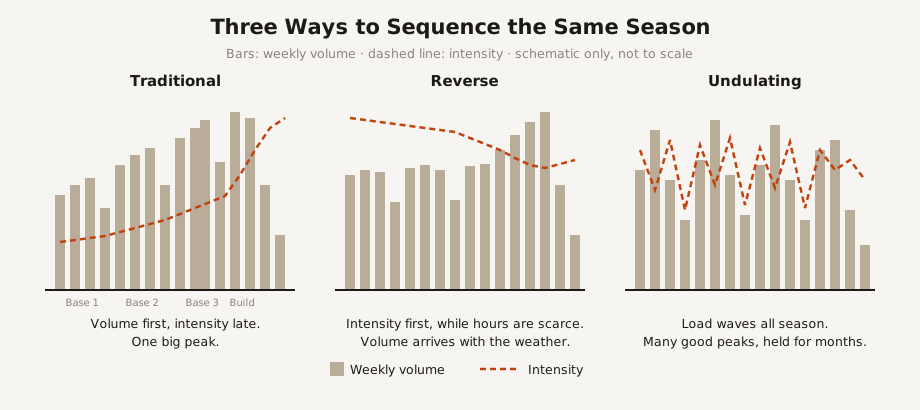
Diagram comparing the three periodization models: traditional starts with high volume that tapers down as intensity rises, reverse does the intensity first and builds volume toward the event, and undulating waves load up and down across the season

1. Traditional (Linear) Periodization

This is the original model, formalized by Tudor Bompa and still the backbone of most endurance coaching — including the ATPs I build. The logic is simple: build the engine first, then tune it.

You start the season with high volume at low intensity — long, aerobic base work — and as the season progresses, volume gradually comes down while intensity goes up. General fitness becomes specific fitness, and specific fitness becomes race form. Most build weeks follow a repeating rhythm of three build weeks and one recovery week, with load stepping up block by block.

The strength program follows the same arc, which is why I periodize gym work the Bompa way: anatomical adaptation, then hypertrophy, then max strength, then power, then light in-season maintenance. Legs get built in the off-season; in season, the bike is the priority.

Example ATP — XC mountain bike athlete, single peak at Nationals in mid-July (illustrative sketch; hours and TSS are examples, not prescriptions)

PhaseTimingWeekly hoursWeekly TSSCharacter of the work
Base 1Late Nov–Dec (4 wks)10 → 13~450 → 600Zone 2 volume, skills, strength adaptation/hypertrophy
Base 2Jan (4 wks)13 → 16~600 → 750Longer endurance rides; sweet spot appears late in the block
Base 3Feb (4 wks)15 → 17 peak week~700 → 850Tempo and sweet spot; max-strength phase in the gym
Build 1Mar–Apr (8 wks)14–16~700–800Threshold intervals; early B/C races for rhythm
Build 2May–early Jun (6 wks)13–15~650–750VO2max and race-specific work; B races used as tests
PeakMid-Jun–early Jul (3 wks)11–13~550–650Short, sharp, race-pace work; freshness rising
Race / taperFinal ~2 weeks7–9~350–450Openers, rest, Nationals

The taper at the end of that build is a studied tool, not just a light week. Reviewing the research on pre-competition tapering, Mujika and Padilla state the goal plainly: “The aim of the taper should be to minimize accumulated fatigue without compromising adaptations” (Mujika & Padilla, 2003, Medicine & Science in Sports & Exercise). Across the studies they reviewed, a well-built taper — volume reduced, intensity kept — typically improved performance by about 3%.

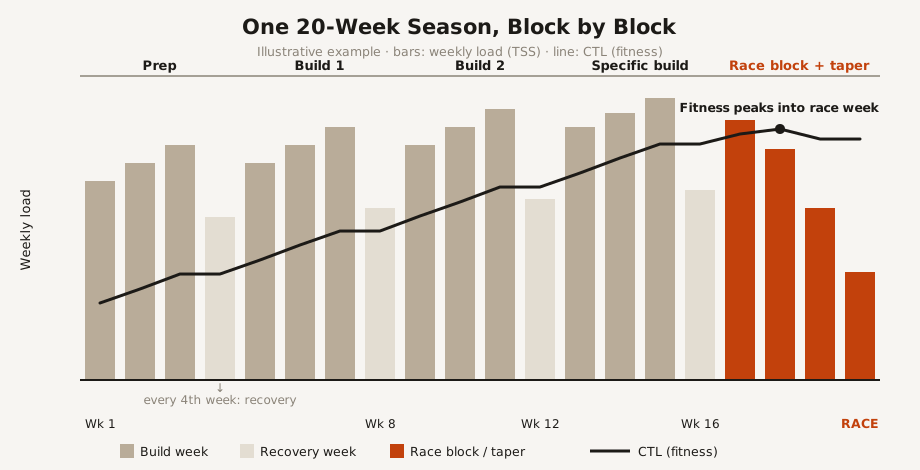
What this looks like across one 20-week season

Here is the traditional skeleton at that 20 week length — five 4-week blocks, each running three build weeks and one recovery week, with the last block given over to race intensity and the taper.

WeeksBlockWhat happens
1–4PrepAerobic base and skills; the 8-week strength program starts; long ride grows steadily
5–8Build 1Threshold emphasis; the key weekday session repeats across the block with more intensity volume each week
9–12Build 2VO2max and threshold; a B-race or simulation ride late in the block
13–16Specific buildRace-specific work; the long ride reaches race volume by the end of this block
17–18Race blockLong-ride volume holds at maintenance; race intensity is added on top
19–20Taper and raceVolume steps down, intensity stays; openers late in race week, then the event
Diagram of a 20-week traditional build: weekly load bars in five 4-week blocks, three build weeks and one recovery week each, with fitness rising steadily into race week

The same skeleton reshapes around the rider, their time to train, and level of fitness. Take the Unbound 200 plans: the Compete version runs 12–17 hours a week on six riding days, with hard days paired with strength on Tuesday and Thursday and a Saturday long ride that grows to race volume. The Finisher version of the same 20 weeks runs 8–12 hours on four to five riding days — same blocks, same rhythm, same taper, with the load scaled to the hours the rider actually has and a Saturday ride that grows more conservatively. The structure does not change. The week inside it does.

Pros

  • Proven over decades across endurance sports; predictable and easy to monitor with TSS.
  • Builds the deep aerobic base and durability that long MTB and gravel events demand.
  • Load progresses gradually, which manages injury risk — especially for developing athletes.
  • Produces the highest single peak of the three models when it’s timed well.

Cons

  • The base phase is long and can feel monotonous; motivation is a real factor by February.
  • Form is built to peak once or twice. Fitness in the “in-between” months is deliberately not race-ready.
  • It assumes you can bank big volume in winter. Not every athlete’s life — or climate — allows that.
  • Short-course racers may arrive at early-season races undercooked on intensity if the base runs long.

2. Reverse Periodization

Reverse periodization flips the traditional sequence. You do the intensity first — VO2max, threshold, and serious strength work — while volume is low, then build the volume later as the event approaches, with the longest rides landing in the final two to three months.

This model is very practical for the rider who lives in harsh winter conditions. It can also be very productive for racers training for very long races, who need the specific long ride to land closer to race day. The reverse model stops fighting the season and uses it — and for the athlete training for a longer race (typically 4+ hours), it applies that same specificity: sharpen the top end and build strength when hours are scarce, then grow the endurance and race specificity as the days lengthen.

Example ATP — gravel athlete, 200-mile A-race in early June, trainer-bound Colorado winter (illustrative sketch)

PhaseTimingWeekly hoursCharacter of the work
Intensity block 1Dec (4 wks)6–8VO2max and threshold intervals indoors; strength 2–3×/wk
Intensity block 2Jan–Feb (8 wks)7–9Intensity maintained; strength progresses to max strength; first longer weekend rides when weather allows
Volume build 1Mar (4 wks)9–11Long ride grows to 3–4 hrs; intensity drops to 1 session/wk
Volume build 2Apr (4 wks)11–13Back-to-back long days; fueling practice at race intensity
Peak volumeMay (4 wks)12–14 peak weekRace-simulation long rides; durability is the whole point
TaperLate May–race day7–9Volume halves, a little intensity stays, race

Pros

  • Fits real life in a real winter: short, high-quality indoor sessions instead of miserable slogs.
  • Strength gets a genuine block, not whatever time is left over.
  • Athletes often reach spring fresher and more motivated than after a long base grind.
  • Well suited to time-crunched athletes year-round, not just in winter.
  • Suits many athletes with time constraints who are training for longer-distance, 4+ hour races.

Cons

  • The aerobic base is shallower. For a 10-plus-hour event, everything rides on the spring volume block going well — a bad April (weather, work, illness) is hard to recover from.
  • High intensity on low volume, progressed carelessly, can spike injury and burnout risk. The ramp has to be paid close attention to.
  • It produces a strong engine but durability — the ability to hold power in hour nine — has to be proven and worked on in those final long blocks, not assumed.

3. Undulating Periodization

Undulating periodization drops the long, steady staircase. Instead, load and emphasis wave up and down across the season — from week to week, and often within the week itself. One week emphasizes threshold, the next VO2max, the next pure endurance and a big long ride, then a genuinely easy week. Fitness is built in waves and then held in waves, rather than marched to a single summit. Of all the models, this one has the most flexibility — and the most room for error. It takes fine tuning, and it takes knowing your methods and your athletes well.

The research literature has been working on this same problem for years. In his review of periodization methodology, Vladimir Issurin notes that alongside the traditional model, “the recently developed block periodization model offers an alternative revamped approach for planning the training of high-performance athletes” (Issurin, 2010, Sports Medicine). An undulating plan is a practical cousin of that idea: concentrated blocks of one emphasis at a time, sequenced and repeated across the season instead of one long staircase.

In practice, this is how a long racing season actually gets managed. A Masters athlete racing from March to October can’t build for six months and peak once — they need to be good in May, better in July, and still good in September. So the plan undulates: two- to three-week loading waves, each with a different emphasis, with short “top-up” sharpeners two to three weeks before each target race instead of a full rebuild.

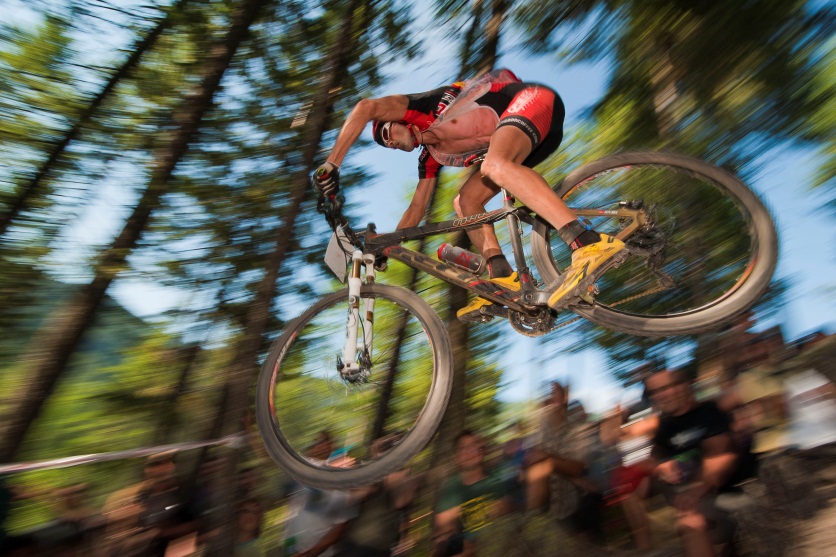
Drew Edsall catching air on a jump during a race
A long season is a string of race days, not one. The plan has to be good at all of them.

Example ATP — Masters MTB/gravel athlete, long season, A-races in May, July, and September (illustrative sketch)

BlockPatternCharacter of the work
Early season (Mar–Apr)3-week waves: threshold wk → endurance wk → recovery wkBase fitness rebuilt in waves; first B races raced “on the way through”
Peak 1 (May)2-wk sharpen → A-raceVO2/race-pace top-up, volume trimmed ~30%
Mid season (Jun)3-week waves: endurance wk → threshold wk → recovery wkFitness held, durability rebuilt, one B race
Peak 2 (Jul)2-wk sharpen → A-raceHighest-quality work of the summer, short and specific
Late season (Aug)3-week waves: VO2 wk → endurance wk → recovery wkWaves fight staleness; strength maintenance 1–2×/wk
Peak 3 (Sep)2-wk sharpen → A-raceFinal peak of the year, then a real off-season

Pros

  • Holds a high level of fitness across a long, multi-peak season — no single make-or-break date.
  • Variety fights staleness and overuse; changing the stimulus is built into the plan.
  • Flexible: a wave can be repeated, skipped, or swapped when life, illness, or weather intervenes, without the whole year collapsing.
  • Often the best fit for Masters athletes, whose recovery is less predictable than a 25-year-old’s.

Cons

  • The peak is usually a notch below a fully dedicated traditional peak. You’re very good several times instead of career-best once.
  • It demands honesty. If the “easy” wave isn’t easy, undulating quietly becomes permanent moderate fatigue — the worst of all models.
  • Harder to plan and to read. Progress shows up as consistency across months, not a clean TSS staircase.

Which Model Fits Which Athlete

A practical matching guide:

SituationBest starting model
Junior or developing elite; one big peak (Nationals, Worlds)Traditional
XC short-course, single-peak seasonTraditional
Marathon MTB or gravel ultra, one A-race, trainable winterTraditional/Reverse
Gravel ultra in June, winter spent on the trainer (Colorado, Upper Midwest)Reverse
Time-crunched athlete, 6–9 hrs/wk year-roundReverse-leaning, with undulating weeks
Masters athlete, long season, 2–3 A-racesUndulating on a traditional skeleton
Stage racing or a dense race calendarUndulating
Injury-prone athlete who needs gradual rampsTraditional, conservatively loaded
Two peaks far apart (e.g., May and September)Traditional with a mid-season rebuild

One honest note: many of the 1-on-1 coaching programs I develop are actually hybrids — a combination of the different methods. When time allows, the skeleton is traditional — Base, Build, Peak, taper into the A-races, tracked by TSS — because it works, and because I can see exactly where an athlete is at any point in the year. But if that athlete is also competing in longer races, the volume gets more specific to that race as it approaches, and it may stay high rather than come down. Once race season hits, a maintenance phase can go into the mix, followed by a rebuild after Nationals to prep for late-season fall races. It gets complex when numerous races spread across a long calendar year — but the general concepts above act as the guide throughout. The model serves the athlete and the calendar, never the other way around.

Whichever model your season calls for, the principles don’t change: progressive overload, specificity as the race nears, real recovery, and a peak that lands on the day — not the month — of your A-race.

References

  1. Mujika, I., & Padilla, S. (2003). Scientific bases for precompetition tapering strategies. Medicine & Science in Sports & Exercise, 35(7), 1182–1187. https://doi.org/10.1249/01.MSS.0000074448.73931.11
  2. Bosquet, L., Montpetit, J., Arvisais, D., & Mujika, I. (2007). Effects of tapering on performance: A meta-analysis. Medicine & Science in Sports & Exercise, 39(8), 1358–1365. https://doi.org/10.1249/mss.0b013e31806010e0
  3. Issurin, V. B. (2010). New horizons for the methodology and physiology of training periodization. Sports Medicine, 40(3), 189–206. https://doi.org/10.2165/11319770-000000000-00000
  4. Rønnestad, B. R., Ellefsen, S., Nygaard, H., Zacharoff, E. E., Vikmoen, O., Hansen, J., & Hallén, J. (2014). Effects of 12 weeks of block periodization on performance and performance indices in well-trained cyclists. Scandinavian Journal of Medicine & Science in Sports, 24(2), 327–335. https://doi.org/10.1111/sms.12016
  5. Rhea, M. R., Ball, S. D., Phillips, W. T., & Burkett, L. N. (2002). A comparison of linear and daily undulating periodized programs with equated volume and intensity for strength. Journal of Strength and Conditioning Research, 16(2), 250–255. https://pubmed.ncbi.nlm.nih.gov/11991778/

Want an ATP built around your races, your climate, and the hours you actually have? That’s exactly what my 1-on-1 coaching includes — a custom annual plan, adjusted as your season unfolds. See how it works at edsallcoaching.com.

Introduction to Power

Training and racing with a power meter — how to read a number that bounces around, set up your Garmin screen, and pace intervals so power stays steady while heart rate rises.

Read article ↓Close ↑

Training and racing with power can help take your training and racing to a new level. However, there are multiple things you need to know prior to jumping into power:

1) Power is instant. You will notice it bounces around a lot. To help you gauge this number better, it is best to take your average power for 3 seconds, 30 seconds, and for intervals. To do that, set up one of your Garmin screens with the following info on it:

  • Lap Time
  • Lap Avg Power
  • 3 second avg power
  • 30 second avg power
  • HR
  • Cadence

By setting these numbers up, it will help you gauge your current power output and help you monitor what you need to change to help pace yourself better for it.

2) Pacing: when using power, you will want to try to hit the average power in the zones I prescribe for a given effort. I.E. If a workout gives you 4 × 2 min intervals in Zone 5, then look at your power zones in Zone 5 and shoot to hit those numbers. Ideally, for a given interval, you want to try to maintain a steady power effort for the entire duration. I.E. Start at 300 watts and end at 300 watts.

Here’s a graph of what a good set of paced intervals with power looks like. Pay close attention to the yellow line, power, and the HR line, red. You will notice that the yellow line is very steady, however, the HR steadily rises. That is a very good paced effort! When you look at your own pacing for a day of using power, you should see a similar trend: slowly rising HR, steady power.

That’s the basics from there. On top of this, make sure you upload all your data to TrainingPeaks. Without it uploaded, it is useless to me and I can’t give you effective feedback on how your power meter training is going.

HR Training Zones

Zones 1 through 5c explained — what each zone is actually training, why Zone 2 does the endurance work, why Zone 3 is mostly a trap, and why Zone 4 gives you the most bang for your buck.

Read article ↓Close ↑

Zone 1 · Active Recovery

When training in zone 1, you ride at a very easy pace, too easy for many cyclists, which is why many tend to neglect this zone. After a stressful workout, it is important to fully recover as soon as possible. The faster you recover, the sooner you will be able to do another intense workout and the faster you will improve. Training in Zone 1 will result in the release of growth hormones and will increase circulation of blood throughout the body. Both are very important in removing toxins and rebuilding muscles. Keeping your training in Zone 1 on rest and recovery days is crucial. Going harder will result in more stress on your body and possibly insufficient recovery.

Zone 2 · Endurance

For the endurance athlete, zone 2 is where a majority of your training should occur. This zone maximally stresses your Slow Twitch (ST) muscle fibers, the muscles responsible for most of your power and energy for exercise lasting longer than 4 minutes. In addition to working your ST fibers, training in zone 2 will result in your body’s ability to burn more fat and less carbohydrates at higher intensities. This is crucial because as your body loses glycogen, or the stored form of carbohydrates, it becomes less and less efficient. It is important to note that training at this intensity maximally overloads the ST fibers, and training at higher intensities will not be as beneficial for that purpose.

Zone 3 · Tempo

Zone 3 is a brisk pace that is neither hard nor easy. Typically, cyclists like to stay in this zone during group rides. It feels relatively fast, but is slow enough to have a conversation and still ride comfortably. Training in this zone should be minimal. This zone is too high to maximally stress your ST fibers and too slow to build your lactate threshold. Often, it is used to prepare yourself for higher intensity workouts early in the year.

Zone 4 · Sub-Threshold

Training in zone 4 will result in the most bang for your buck. Zone 4 training specifically targets improvements in your LT. You are teaching your body to remove more lactic acid and produce less at a given output. At this intensity your body is removing lactic acid faster than it is being produced, which allows you to ride at this intensity for a long period of time prior to being forced to stop. If you increase the intensity to zone 5 or higher, lactic acid will begin to accumulate and eventually force you to stop. In addition to this, training at higher intensities will require longer recovery periods between workouts. This is why it is very important to include interval training at zone 4. Typically, you can sustain an interval for about 20–60 minutes at the lower end of zone 4 and can hold a steady pace for about 12–30 minutes at the higher end of zone 4. A good part of your training should involve training in zone 4, but remember, more is not always better. It is crucial to schedule enough recovery time between workouts and blocks of training, especially when you begin training in zones 4 and higher.

Zone 5a · Supra-Threshold

When you are training in zone 5, lactic acid is slowly beginning to accumulate in the body. In most Time Trials that are around 40k, you will be hovering right around this zone. Training in this zone will increase your body’s ability to tolerate lactic acid. More specifically, you will be able to continually produce power and speed with more lactic acid in your system.

Zone 5b · Aerobic Capacity

Training at this intensity can be a very effective tool to increase your endurance performance. This training also requires very little time. But, training at this intensity also requires a lot of rest and recovery between workouts. Without the proper recovery, you run the risk of overtraining, resulting in decreased performance. The average person requires around 48–72 hours of recovery between interval workouts of this level. The types of intervals range from 1–6 minutes and have periods of equal to double the amount of recovery time between them. Be careful when training at this level. It can be very useful, but it can easily send you over the edge.

Zone 5c · Anaerobic Capacity

Training in Zone 5c involves very short bursts of high-speed training. The benefits result in improved performance above your aerobic capacity. Situations such as sprints and mass starts in mountain biking are both examples of where this type of training may benefit you. In addition, training at this intensity will result in improved efficiency and economy of work, resulting in less wasted energy. Once again, this intensity requires sufficient recovery prior to your next important workout.

Nutritional Advice: On and Off the Bike

The basics of a solid fueling plan — eating low-GI away from the bike, the post-ride recovery window, chocolate milk, and Drew’s simple calories-per-hour formula for hard rides and races.

Read article ↓Close ↑

What you eat outside of riding and while riding/right after riding can make a big difference in how you perform. This is a basic rundown of the basics to a solid nutritional plan.

Outside of Riding

  • Eat small meals throughout the day. Aim for 5–6 meals rather than 3 large meals a day. This keeps your energy levels (i.e. blood sugar) more steady and also avoids weight gain and cravings.
  • Anything you eat 2+ hours outside of riding should be low on the glycemic index (GI Index; google it for details). Basics of low GI index: lay off processed foods, foods high in sugar. Eat lots of vegetables, lean meats, good fats. Avoid high sugars, sweets, and processed foods such as cake, cookies, donuts.

Examples of what to eat:

  • Lean meats / Fish: Fish is great! 2–3 times a week or more. Lean meats: 2–3 times a week, but keep it lean… steak is great, as well as chicken.
  • Carbs: potatoes, fruits, vegetables, rice. All good examples, but once again look at the GI index. 2+ hours out of riding should be low GI Index. While riding and right after riding, should be High GI Index! (i.e. absorb fast = recover faster!)
  • Fats: fish oils (salmon, fish!), fats in nuts such as almonds is very good also. Coconut oil. Lay off lots of grease, butter, and any fats that are solid at room temp (these are saturated fats… don’t want these!)
  • Moderation/Variety: try to keep variety: lots of colorful and natural foods are always better than processed.

Post Ride

This is very important! Right after your hard/long rides/races get a recovery drink with 90+ grams of carbs and possibly some protein also. A 4:1 carb to protein ratio is ideal. Chocolate Milk is an excellent example!

Here’s an article with more details on that: Strategies for Optimum Recovery — TrainingPeaks

During Ride

Multiply your weight in pounds × 2 (i.e. 100 lb athlete = 200). This is the amount of calories you need per hour on the bike. This is ONLY for your hard rides, races and long rides. For shorter, easier rides, water is ok. But, for the harder rides, hit these calories right and you will recover faster, improve faster, and perform better in each hard workout or race.

  • What you take in is up to you. Find a product that is mainly carbs. It can be a drink, gel, gummies, or solid food. Make sure you are comfortable taking it in while riding.
  • Experiment: during your hard and/or long rides, try what you think you like and make sure you do indeed like it. Pay attention to energy levels. You want to feel better than normal and not worse! In addition to this, use something you like the taste of.

Fueling is worked into the long-ride progressions of every Unbound and Leadville plan — and covered 1-on-1 in coaching.

More Training Articles Coming Soon

New training articles are coming soon. Check back for training tips and race preparation advice from Coach Drew.

Questions in the meantime? Email [email protected] — Drew is happy to point you to the right plan or article for your next race.