








These are the main concepts and principles I use for every athlete I coach. This is the science behind building periodized training plans for athletes.
Concept #1: Progressive Overload
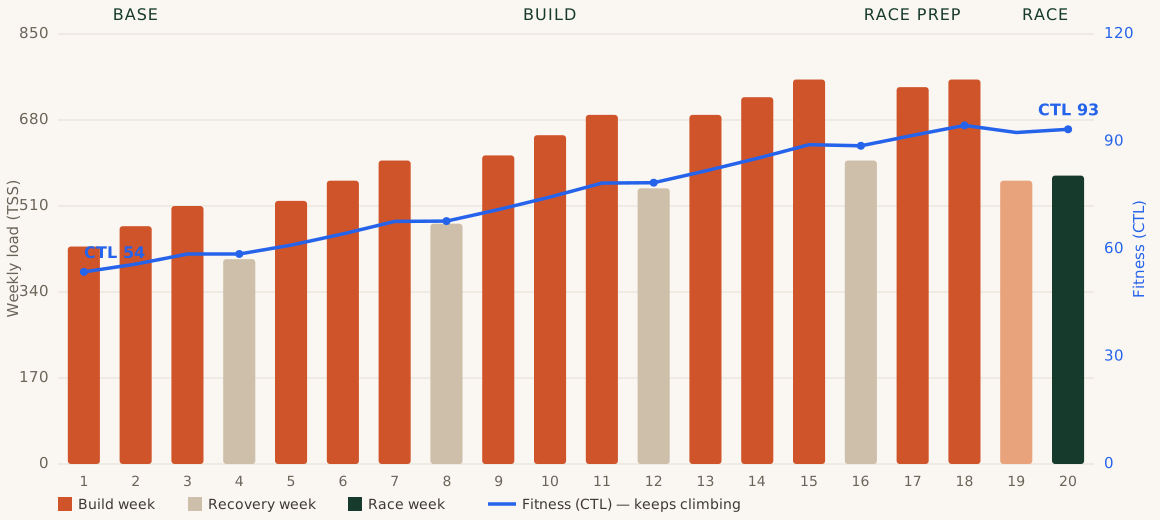
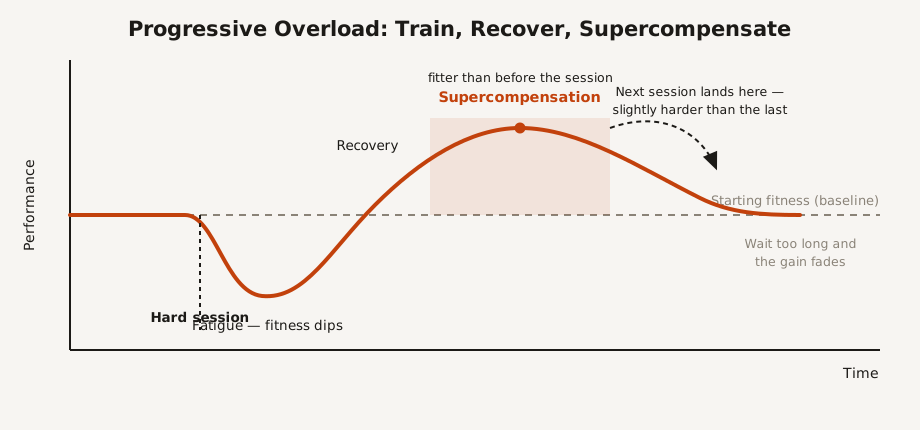
To improve, you have to overload your body. Meaning, make things tougher in order to improve. This “overloads” your body, and then with the right amount of rest your body supercompensates — leading to more power, more efficiency, and ultimately just a faster and stronger you!
There are two main ways to make your training tougher and lead you to getting faster:
- Volume: simple — make rides longer (i.e. base training)
- Intensity: makes things tougher (i.e. intervals)
Volume. Adding volume is a great way to challenge your body. It is the most common form of traditional base training: add more miles and time for 2–3 months at the beginning of your training year. This is very much based on this “volume concept,” and it does the job of challenging your body. There are advantages to doing these straight base miles (long rides, Zones 1–3 and steady): increased fat utilization, increased threshold, increased mitochondrial density, increased cardiac output, etc. But this model often presents a common problem: it requires more time.
Going back to progressive overload — if you don’t make it harder than previous years (meaning more time on the bike), it will most likely lead to you coming back into the season in similar shape as last year… because you gave it the exact same overload. If you are a Pro rider, maybe that 20–30 hour week set you up well and you want to repeat it. Fantastic! You are a Pro and that’s all you do! The majority of riders out there do not have that amount of time to train. Meaning, if you spent 14 hours a week training last year on base Zones 1–3 rides, and you do the same this year, you are producing a very similar overload and will most likely see a similar state of fitness come race time.
The average rider does not have the time, especially in the winter, to progressively make this tougher. 12–16 hours is the typical max for most riders per week. If you are not the “average” rider and have more time: great! Add more time to the training plans! Maybe more base is good for you. But the plans I put together take into account what I feel is best for the average rider for the specific racing you are doing, and apply the best concepts possible.
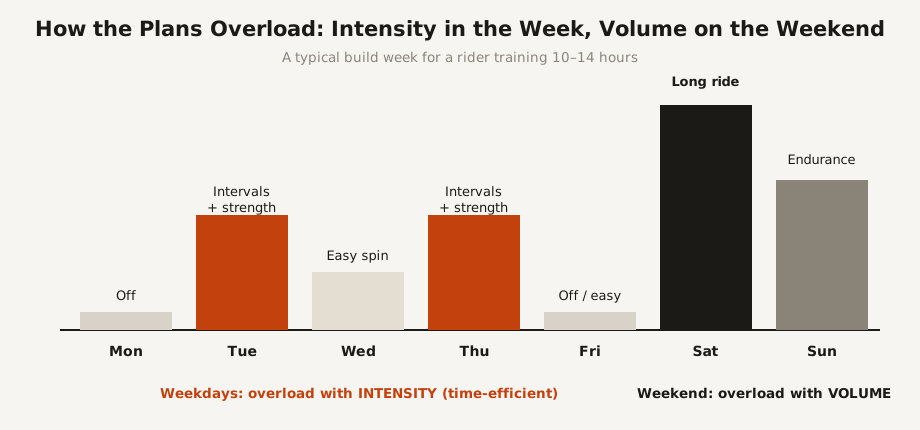
Many times this means we are overloading the weekend rides with volume, because you have more time to train on the weekends. Overloading the weekends still gets you the volume benefits I mentioned earlier. And it fits most riders’ schedules better.
And during the week we are overloading with intensity, because many athletes have full-time jobs and other commitments. So time is an issue during the week. 2–5 hour rides are tough to get in — and that’s what traditional base training is about… long, steady rides!
Intensity. That brings us to the next point. High-intensity short efforts are a very common way to drive improvement, both for mountain bike racing and gravel racing. Specific targeted intervals have race-proven results and are scientifically proven methods of improvement. Google the terms HIIT, Threshold Training, or Tempo, and look over the research articles you find. Intervals give you a lot of bang for your buck: less time on the bike, with a lot of results! Do these right, and you will come into the early season riding very well — and with the right maintenance and transition, come into your top races riding strong also. On top of that, you can easily overload your body every week without needing to increase your time during the week. And you get great benefits!
Going back to the main concept: progressive overload. Pick either intensity or volume, and focus each ride, week, or month on building this specific energy system. The effort needs to be longer or harder than previously. With the proper rest, you will improve and continue to get better.
Concept #2: Individualization
The training plan should be specific to the individual. That’s you! Here are a few areas to consider:
- Age
- Past fitness and sports background
- Time to train
- Type of athlete: what drives you
- Strengths and weaknesses
- Goals
Evaluate these by asking lots of questions and getting to know yourself better. Try to determine what drives you, and how to manipulate the training to best suit that need. Also take into high consideration the sports you have played in the past, your strengths and weaknesses, and the time you have to train. And age — age can make a dramatic difference in your recovery rate and your ability to train.
Concept #3: Specificity
Get specific to the event you are getting ready for.
The timing of this is important also. Typically, starting 2–3 months before your key event(s), you will want to make sure a majority of your key workouts are specific to that event. i.e. If you are expecting lots of 1–3 minute climbs, then incorporate training designed around that. If it’s a longer race, then make sure there are rides building up to that distance — and ideally building up to that intensity also.
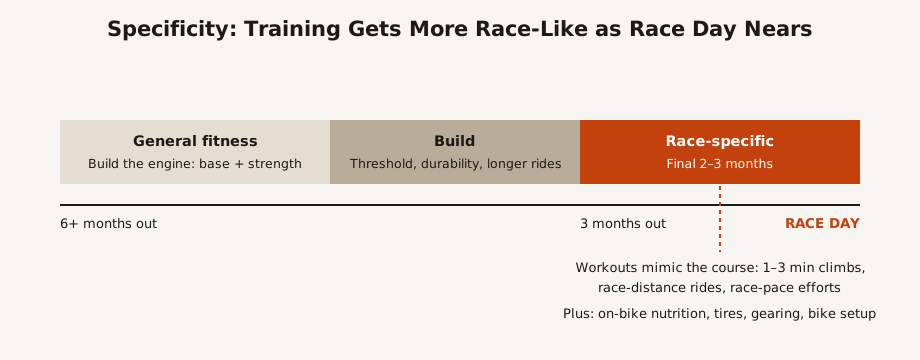
If you’re getting ready for mountain bike racing, that might be a combination of time trial work on the trails, more rides on mountain bike trails, and race intervals geared toward that specific race. Gravel racing might include more group rides combined with intervals specifically designed around the gravel race you are getting ready for. The Rad Dirt Fest, for example, is long steady climbs, whereas UNBOUND is an entirely different animal — shorter rolling hills mixed with headwinds much of the time. Other things to consider to improve specificity: nutrition on the bike, tire and bike selection, gearing selection, bike setup. These are all very important, and getting more and more specific starting 2–3 months out can give you an advantage over your competition and prepare you better for race day.
These concepts are the main ones I focus on when looking at an athlete, and as a coach I will continue to evaluate these throughout the year(s) I work with each athlete. If you nail these down, it will help you analyze your training and help you continue to improve throughout the season and years.
Every plan at Edsall Coaching is built on these three principles: overload that fits your life, built around you, and specific to your race. Browse the training plans →
References
- Meeusen, R., et al. (2013). Prevention, diagnosis, and treatment of the overtraining syndrome: Joint consensus statement of the European College of Sport Science and the American College of Sports Medicine. Medicine & Science in Sports & Exercise, 45(1), 186–205. doi:10.1249/MSS.0b013e318279a10a
- Issurin, V. B. (2010). New horizons for the methodology and physiology of training periodization. Sports Medicine, 40(3), 189–206. doi:10.2165/11319770-000000000-00000
- Holloszy, J. O., & Coyle, E. F. (1984). Adaptations of skeletal muscle to endurance exercise and their metabolic consequences. Journal of Applied Physiology, 56(4), 831–838. doi:10.1152/jappl.1984.56.4.831
- Joyner, M. J., & Coyle, E. F. (2008). Endurance exercise performance: The physiology of champions. The Journal of Physiology, 586(1), 35–44. doi:10.1113/jphysiol.2007.143834
- Gibala, M. J., et al. (2006). Short-term sprint interval versus traditional endurance training: Similar initial adaptations in human skeletal muscle and exercise performance. The Journal of Physiology, 575(3), 901–911. doi:10.1113/jphysiol.2006.112094
- Milanović, Z., Sporiš, G., & Weston, M. (2015). Effectiveness of High-Intensity Interval Training (HIT) and Continuous Endurance Training for VO₂max Improvements: A systematic review and meta-analysis of controlled trials. Sports Medicine, 45(10), 1469–1481. doi:10.1007/s40279-015-0365-0
- Stöggl, T., & Sperlich, B. (2014). Polarized training has greater impact on key endurance variables than threshold, high intensity, or high volume training. Frontiers in Physiology, 5, 33. doi:10.3389/fphys.2014.00033
- Tanaka, H., & Seals, D. R. (2008). Endurance exercise performance in Masters athletes: Age-associated changes and underlying physiological mechanisms. The Journal of Physiology, 586(1), 55–63. doi:10.1113/jphysiol.2007.141879
- Fell, J., & Williams, A. D. (2008). The effect of aging on skeletal-muscle recovery from exercise: Possible implications for aging athletes. Journal of Aging and Physical Activity, 16(1), 97–115. doi:10.1123/japa.16.1.97
- Issurin, V. B. (2013). Training transfer: Scientific background and insights for practical application. Sports Medicine, 43(8), 675–694. doi:10.1007/s40279-013-0049-6