

100-Mile MTB Training Plans
The full hundred — mountain or gravel. Start with the core distance plans, or go race-specific for the exact course you are racing.
Inside the plan
A week inside your plan — and the season it builds
Every plan is built on the same chassis: hard days paired with strength, real recovery, and a long ride that grows toward race volume. Most build weeks follow a 3-week build / 1-week recovery rhythm, and the final block adds race intensity before a taper into your event — and the week itself reshapes around your level, from Finisher to Compete.
Which level fits you?
Compete — Race to place. The highest volume and intensity, 6 riding days a week — for experienced racers chasing podiums and PRs.
Intermediate — Race strong. A step down in hours from Compete with the same structured quality work — for riders with a solid base who want a serious performance.
Finisher — Get to the finish line strong. The fewest hours, 4–5 riding days a week — the essential training to complete the distance well, without the extras.
Time Crunched — Big goals, small schedule. Short weekday sessions, Fridays off, and the long work on weekends — every hour made to count.
Masters 40+ — Built for riders over 40. Real intensity with recovery planned in, plus strength work to keep you durable.
One sample build week — your level changes it. Finisher plans ride 4–5 days with more rest, Intermediate plans ride 5 days and move a strength session to Monday, Compete plans ride 6 days, and Time Crunched plans keep only the highest-value sessions. In most plans, every fourth week is a lighter recovery week at every level.
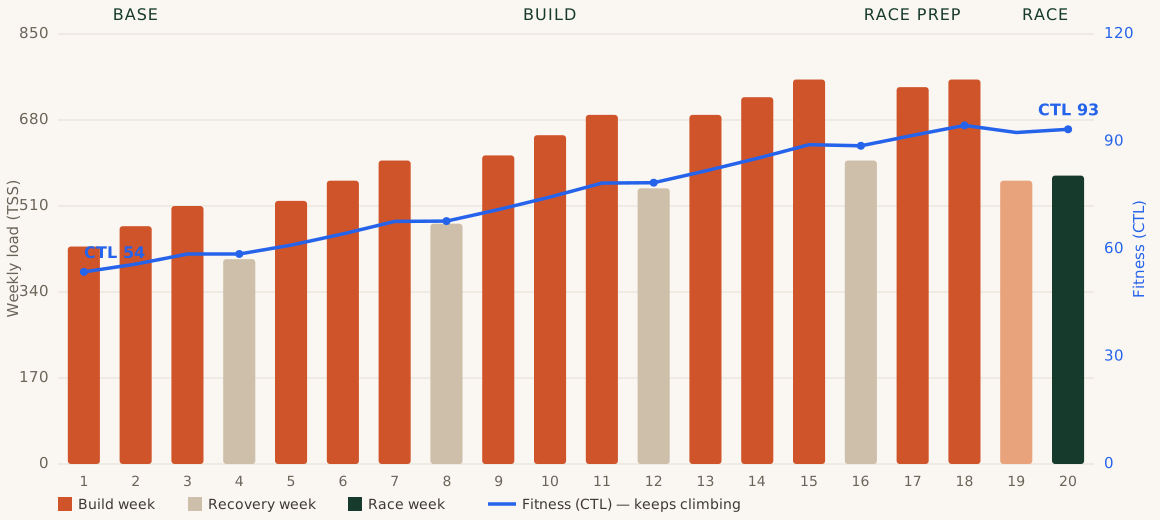
An example 20-week build
Here is one example end to end — stack those weeks into a 20-week plan and this is the shape, the same view you will watch in TrainingPeaks. Each bar is one week’s training load in this example build; the lighter bars are the recovery weeks. The load steps up in three-week blocks, peaks in the race-prep block, then steps down so you taper into race day fresh.
Why the load climbs in steps — and why the recovery weeks are non-negotiable: Progressive Overload, Specificity, Individualization — the three principles behind every Edsall plan.